This is part two of my Great 8 FKT attempt, an adventure in honor of Matthew Baxter III. See part one here.

After Alan dropped me off, I stood at the trailhead all alone, trying to stay anchored in the magnitude of the feat I was about to undertake. I stared out across the ocean toward the great "canoe" across the strait, thinking of all the distance I would cover in the next week, if all went according to plan. I took a deep breath, and away I went.
--
The Rakiura Track
The Rakiura Track is one of the lesser-traveled Great Walks. Most people don't make it down to New Zealand's "third island" and it has a reputation for being a muddy swampland. I saw very few people on trail and was delighted to have beautiful beaches and rolling jungle track all to myself.

The track is split into thirds along a peninsula - following along one side, crossing overland through the jungle, then back along the other side.

 |
"How is nobody else here?!" |
 |
| Evidence of the old logging industry.
Stewart Island lived up to its swampy reputation. Since it had rained so much over the previous days, the mud underfoot caused me to pitch and stumble in places.
|

 |
| The Halfway Tree. Of course! |
 |
| "Windthrown branches." |
 |
| A typical DOC hut. |
 |
| Hitting the ocean again on the western end of the track. |
 |
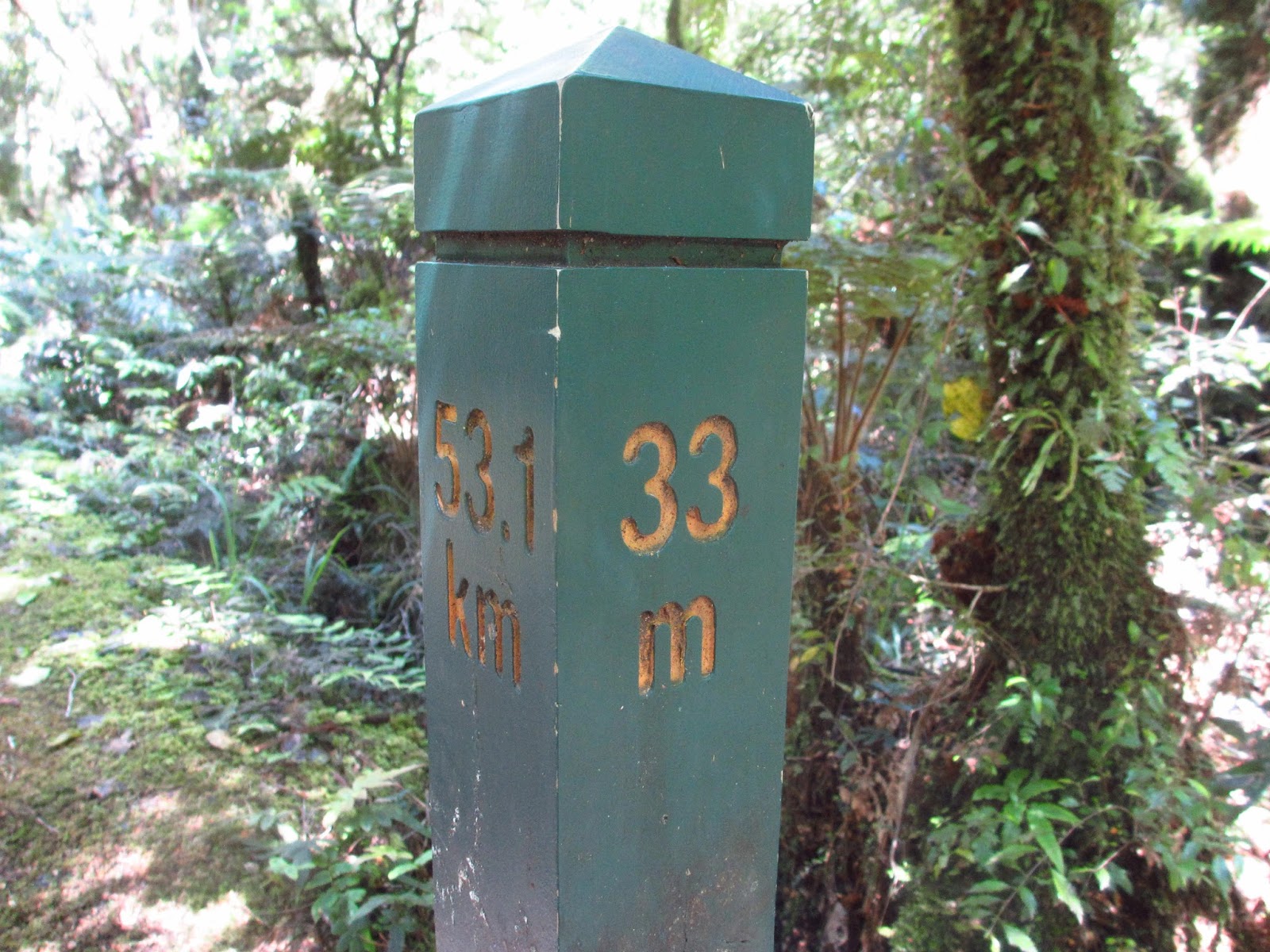
| 1 down, 7 to go. |
I am frequently asked how I keep myself entertained during long hours of running. The truth is that 90% of my thoughts are absolutely banal, pertaining directly to my mileage, eating, drinking, and waste management needs. However, sometimes, I put my mind toward a thinking project or word game. Somewhere in the middle of the Rakiura Track, I decided I would write a haiku for every track I completed. For the Rakiura, I came up with this:
As I arrived in Te Anau that evening, I was greeted with a glorious spot of sunshine and my fatigue lifted. I settled into a routine I would follow for the next couple days at the hostel: heat and eat soup and copious amounts of buttered bread, banter with hostel employees about the day's adventures, hard boil eggs for the next morning's breakfast, pack running vest with food and water, set out clothing, update social media, check weather conditions, go to bed before dark.
Rolling, winding muckAt only 20 miles long, the Rakiura Track was supposed to be a "warm-up run" for the rest of the week to come. However, with the mucky conditions, the run had been harder than expected. I emerged red-faced and wet from rain and humidity. One of my knees was a bit sore from all the sliding about. Though I felt good overall, I was also tired. It was only the beginning and I tried to put the rest of the walks out of my head. I knew if I looked at my goal in its entirety, it would feel impossible, so I focused on the immediate tasks at hand: shower, catch a ride back to Oban with Alan, ferry back to the South Island, drive to Te Anau.
AND gravel, through rain forest.
Pristine beaches, too.
 |
| A rare commodity in Te Anau: sunshine! |
The Kepler Track
I arrived to the start of the Kepler Track at 5:52am the next morning with much enthusiasm. The Kepler is 37 miles (60km) long, and is the site of one of the most popular ultramarathons in the country. The race had taken place just a couple weeks prior. As I had told people of my plans to run the Great Walks, many had commented on remarkable speeds on the Kepler: "There are guys who run it in less than five hours!" Impressive, indeed.
I, personally, had no intention of speeding through the Kepler. It would be the second longest track of the whole endeavor, and would include a long climb up a mountain early in the day. The sunny skies of the day before had morphed back into a more typical Te Anau morning: overcast drizzle. I set off around Lake Te Anau at a relaxed pace and reached the Brod Bay backpackers campground in good time. No campers were stirring yet, so I quietly passed through and settled into a brisk walk up a five-mile incline.
As I gained the ridge and the incline began to mellow out, I was greeted with a chilly surprise: snow! Well, graupel, really. I had to laugh. I had experienced every kind of weather condition imaginable during my "summer" thus far in New Zealand. I laughed, bundled up, and pushed on to the Luxmore Hut.
With frozen fingers and wind-chilled cheeks, I greedily entered the Luxmore Hut to warm up and sign the register. Each hut has a trail register that can be used in an emergency to track where hikers are along the route. It would also serve as "proof" of my FKT, should it come under question down the line. I arrived right in the swing of breakfast time, and I was startled at the immensity of the hut and its commotion. With a capacity of 54 visitors, the dining hall was a flurry of activity: backpacks and rain coats and cooking stoves and breakfast plates and conversation. After two hours alone on trail that morning, I was not ready for the cacophony of sounds, sights, and smells. I staggered back outside, where I was greeted by a mother-son pair of Americans. The son recognized immediately that my silly outfit and lightweight running vest surely meant I was running that day? I affirmed that to be the case. He giddily explained that he was just getting into ultrarunning and the he, too, hoped to run the track one day. He began peppering me with questions about what I was eating and how I liked my rain skirt and how long I thought it might take me. As I felt my fingers starting to go numb again, I politely mentioned that I'd better get going if I was going to beat darkness that night, and after a quick round of photos for one another, I bid them well on their journey.
The next section of the track would take me on a winding set of ridges, some wind-blown, some snowy, some dancing among the clouds, revealing mountains beyond mountains. Up there, I got out of the internal monologue of personal needs and felt very present. I felt something bigger than myself. I thought of Matt Baxter, whose life was honored through the Matthew Baxter III Award. I thought about everything I had heard about Matt - his adventurous spirit, his giving nature, his commitment to friends and family. I thought about how his actions continued to give gifts to the world. I thought about my own life and whether I was living up to my potential, what gifts I might leave behind if I were to pass away. I danced among the clouds and among my dreams.


From there, the track descended steeply into the rainforest to the Iris Burn Hut, which had a bold claim:

I did not stick around long enough to decide if I agreed.
From Iris Burn, the track would descend just a small bit more, and then it would be 15+ miles of flat all the way back to the car park. By the third or fourth hour of flat terrain, I was cross-eyed, sore, and tired. I began hallucinating that the trailhead was around every corner. It could not come soon enough.
Finally, the trailhead sign popped into view. Phew.
I, personally, had no intention of speeding through the Kepler. It would be the second longest track of the whole endeavor, and would include a long climb up a mountain early in the day. The sunny skies of the day before had morphed back into a more typical Te Anau morning: overcast drizzle. I set off around Lake Te Anau at a relaxed pace and reached the Brod Bay backpackers campground in good time. No campers were stirring yet, so I quietly passed through and settled into a brisk walk up a five-mile incline.
 |
| Lake Te Anau |
 |
| What a bro(a)d! |
 |
| "Summer in New Zealand." |
 |
| Style points. |


 |
| Honoring Matt among clouds, among dreams. |
From there, the track descended steeply into the rainforest to the Iris Burn Hut, which had a bold claim:

I did not stick around long enough to decide if I agreed.
From Iris Burn, the track would descend just a small bit more, and then it would be 15+ miles of flat all the way back to the car park. By the third or fourth hour of flat terrain, I was cross-eyed, sore, and tired. I began hallucinating that the trailhead was around every corner. It could not come soon enough.
 |
| Flat through a valley. |
 |
| Flat through a marsh. |
 |
| Flat by a river. |
 |
| 2 down. 6 to go. |
Snowing and blowing.
Thank you for a white Christmas.
Lonnnnnng flat. Legs tired.
I tried to blot out thoughts about how I could possibly run another 33 miles the next day as I drove to the Te Anau visitor center to pick up my Milford Track letter of approval. I reasoned with myself that once I ate a meal and got a good night's sleep, I would probably feel a lot better. I was getting to be a pro at delaying doubts. One step at a time. If I just put off impending dread, I found that most times, it would fail to be an issue. It was a mental shell game, and as long as I could distract myself with other thoughts, I would be fine.
That evening, I found a happy distraction when I ran into Karen and Bob, two ultrarunners I had met a week or so earlier in my travels. They asked me how the run was going and I animatedly told them about how much fun I was having. Seeing their excitement for my journey was a huge uplift and I went to bed with a smile on my face.


The track was magnificent right from the get-go. I had dreamed of hiking the Milford Track for many years, and it completely lived up to expectation. We wound along a river and through a narrow valley bounded by huge cliffs adorned with many small waterfalls from recent rains.
There was only one problem: I felt terrible. My legs couldn't seem to move and my knee screamed out in pain. I kept checking my watch and recalculating my arrival time to the afternoon ferry. I became anxious with my glacial speed. Even the slightest uphill felt torturous. My breathing became ragged and I began to cry. I felt hot and itchy and uncomfortable. I stopped in the middle of the valley, peering up at the walls and thought, "I'm never going to make it. Shit." I pondered whether I should turn around and try to catch one of the ferries from the dock I had just left. "Fuck," I said out loud. It was only the third track, and the one I was most excited to see. Really, Katie? Here? This is where it ends? I was most displeased.
I calmed myself down and began a game that is familiar to any ultramarathoner: talking myself off the quitting ledge. I went into trouble-shooting mode. Don't think about the next six days. Just think about now. Maybe you're just sleepy tired. That'll wear off in a little bit. Maybe you're just hungry. Let's eat something. Maybe you're just dehydrated. Let's drink some water. Maybe your legs haven't warmed up yet. It's early still. Let's walk for five minutes, then try again.
At some point during the walking bit, I saw a restroom. I hadn't known I needed to go, but as soon as I saw it, I ran full speed and quickly disavowed myself of the contents of my bowels. Within that process, I must have also disposed of whatever was laying waste to my body, as I suddenly had a new-found vigor and a spring in my step. Just like that, all of the doubt was gone and my legs felt fine. Game on!
I bounced happily down the trail and eventually ran back into Ryan. "I'm a human again!" I announced. He chuckled and we began to learn about each others' lives as we headed up the valley.


 At some point, Ryan ducked into a hut to sign the register and refill his water. Knowing that a new low could come at any time, I continued up the climb to MacKinnon Pass on my own.
The cool thing about running the Milford Track, as opposed to walking it, is that I had long sections of the track all to myself. Since the hikers are meted on a tight four-day hut-to-hut schedule, they tend to hike in a tight clump, spread out by only a mile or so from fastest to slowest hiker. I would pass a glut of hikers, then have the trail all to myself until I reached the group from the next hut section, many miles later.
The climb to MacKinnon Pass was sublime and I was grateful my legs had seemed to wake up from their doldrums. I power-hiked and jogged all the way to the stone monument on top of the pass. I was greeted by a phenomenal view, a large group of hikers, and a band of cheery keas: alpine parrots. Keas are notoriously smart and love to steal food at every opportunity. I watched them deftly swoop in and open a zipper to an unattended backpack just as I arrived.


The pass was windy and cold, but I wanted to stick around to watch the clouds dance among the mountains and I wanted to check in on Ryan, who I was surprised was still behind me. I put on my layers and chatted with the backpackers. Soon enough, Ryan arrived, in great spirits and delighted to see the views just before the clouds closed in again.


I awoke from my nap upon arrival to the hostel, bid adieu and good luck to Ryan, and yawned my way through the rest of the evening's tasks. My body was worked. Luckily, I was too tired to worry about the next morning's run. I taped my knee, set my alarm, and immediately fell into a deep sleep.


As I ascended, the views just kept getting better and better, winding from one mountain valley to another. It reminded me of my home in Yosemite and I knew it was my favorite track yet.
Then, as I began to descend, the wheels fell off. My knee had been stiff, yet compliant, on the uphill, but the downhill started an all-out rebellion. Each step inspired a yelp. I tried stepping sideways, walking backwards, lengthening and shortening my stride, leaning on my trekking poles at new angles. Nothing eased the pain. I had already taken 200mg of ibuprofen earlier that morning and the pain was still intolerable. I knew I couldn't take any more ibuprofen - studies on ultrarunners show that even small amounts of pain medications during endurance events can create significant kidney issues, sometimes resulting in death.
I sat down in a patch of grass and pondered what all of this meant to me. I was 10 miles from my car. There were many hours of daylight left. I was supposed to be driving 10 hours that afternoon to the beginning of the Heaphy Track. I could still drive there that night, get a few hours of sleep, and start again in the morning. I reasoned that the 10 hours in the car would be a nice rest on my legs, that I would be able to take anti-inflammatories once I got to the trailhead and I would ice my knees on and off all evening to prepare.
I kept hobbling down the Routeburn, determined that things could always change for the better, as I had discovered repeatedly in the days prior.

I started thinking of the next day's run: the Heaphy Track. At 49 miles, it was the longest trail of the whole adventure. Though it was mostly flat and uphill, I worried about a few things: a) there were zero opportunities to bail out early - the track is very remote. b) my car was also going to be shuttled for me from the beginning to the end, so if I turned around, I would be stranded at a remote trailhead, likely with no cell phone signal, and possibly very few other people. If I was going to start the Heaphy, I would need to commit to finishing.
I thought about the probability of finishing - not just the Heaphy, but the whole thing. After finishing the Routeburn, I would be done with half of the Great Walks, but not even half of the mileage. I would have done 110 miles out of 248. I decided to have some real talk with myself: did I really think my knees, which were getting worse day-by-day, would bounce back enough to finish 138 miles more? Even if I could do it, would I want to do that to my body, potentially risking being injured long-term?
I hemmed and hawed. I thought about what it would mean to give up on my dream. I thought about what it would mean to be reckless with my body in search of some basically arbitrary goal. I vowed to make no decisions until I finished the Routeburn. At one point during my descent, my knee started to feel a little better, so I took a couple of furtive steps, picking up the pace to a gingerly jog, but my knee buckled in pain and I cried out as I fell to the ground. Yikes.
I knew it was over.

I began to get sad about some of the tracks I would not see, but each time I tried to tell myself my knee pain wasn't that bad, a sharp pain would radiate from my knee to my hip, and I would scrap any thoughts of continuing onward.
--
I also wouldn't get to see parts of the country that I had really wanted to. I was supposed to be out on trail, but instead, I had two more weeks to kill in New Zealand with a basically non-functional body. I felt aimless.
Before starting the Great Walks, my journey felt full of community and support. I knew I had the Yosemite and Baxter Award communities back home cheering me on, and I had been delighted to make many friends in my New Zealand travels. Now, I felt more alone than ever. I didn't want to talk to anyone back home and own up to my failure. I had lost my enthusiasm for meeting new people.
1. Running 100 miles over four days is actually way harder than running 100 miles in one continuous push.
Overnight rest causes lactic acid and muscle stiffness to set in, which must be overcome every day. Plus, the logistics of getting to trailheads, cooking meals, checking weather, picking clothing for the conditions, etc. are incredibly taxing. Not having a crew to support on those things took a stronger toll than I anticipated. It took time, but I grew to feel quite proud of my self-sufficiency, especially when things got hard out on trail. I knew those lessons would come in handy, whether in future trail races or when facing tough times in life.
2. Failure is okay. Maybe it's even good.
Always striving for deeper achievement, I am uneasy with failure. I had to remind myself of my goal. It wasn't about the FKT. It was about finding a really hard goal and seeing if I could accomplish it. It was about digging deep and inspiring others to do the same. Maybe there was something more beautiful in the failure, in extending myself to the point of meltdown. Maybe more women should dare to fail more often. Maybe it's this perfectionistic streak that holds so many women back from pursuing their dreams.
The Milford Track
The next morning was a particularly early one. Captain Mark picked me up at the hostel before 4am, giving us two hours to drive to the boat put-in, meet up with Ryan and his crew, ferry across Lake Te Anau, and start the Milford Track. That would then give the two of us roughly 10 hours to complete the 33 miles in time to catch the Department of Conservation (DOC) ferry on the other side - a generous buffer in case of a complete melt-down or significant mishap on trail.
Ryan and his crew of two, Nigel and Paul, were right on time, and we set off across the lake as the darkness began fading to daylight. Upon arrival to the start of the Milford Track, there was a personal boat already moored at the landing. Mark mused that it might be a fisherman. As we stood on the dock taking photographs and making final preparations for the run, a man came out of the boat...wearing a t-shirt and underpants, and nothing more. He then proceeded to have a very normal conversation about what we were doing and how lake conditions were, completely unfazed by the fact that he was standing there in his underwear.
I tried not to giggle.

I was chilled from the breezy boat ride and I could feel the clock clicking down for our ferry arrival that afternoon, so I declared that I was heading out. Ryan agreed and we began trotting down the trail together.
After a couple of early pack adjustments and an acknowledgment that my legs were pretty tired, I told Ryan to go on ahead. He had only run one track (the Rakiura) thus far and had relatively fresh legs. I knew that I would probably go slower and take fewer stops, while he would probably go faster, but take more stops at huts and for photos. We wished each other well and figured we'd see each other soon.
Ryan and his crew of two, Nigel and Paul, were right on time, and we set off across the lake as the darkness began fading to daylight. Upon arrival to the start of the Milford Track, there was a personal boat already moored at the landing. Mark mused that it might be a fisherman. As we stood on the dock taking photographs and making final preparations for the run, a man came out of the boat...wearing a t-shirt and underpants, and nothing more. He then proceeded to have a very normal conversation about what we were doing and how lake conditions were, completely unfazed by the fact that he was standing there in his underwear.
I tried not to giggle.

I was chilled from the breezy boat ride and I could feel the clock clicking down for our ferry arrival that afternoon, so I declared that I was heading out. Ryan agreed and we began trotting down the trail together.
After a couple of early pack adjustments and an acknowledgment that my legs were pretty tired, I told Ryan to go on ahead. He had only run one track (the Rakiura) thus far and had relatively fresh legs. I knew that I would probably go slower and take fewer stops, while he would probably go faster, but take more stops at huts and for photos. We wished each other well and figured we'd see each other soon.


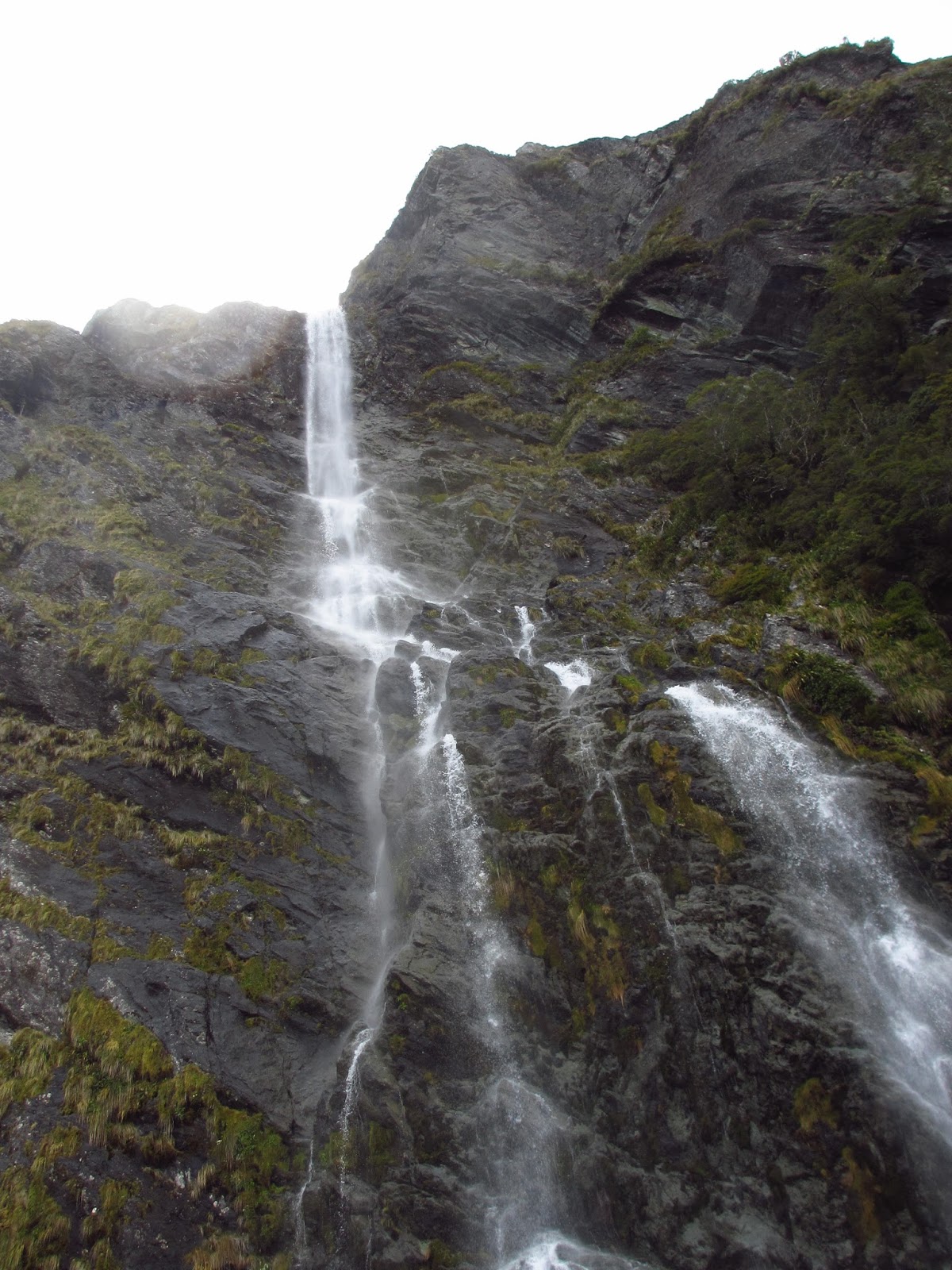
The track was magnificent right from the get-go. I had dreamed of hiking the Milford Track for many years, and it completely lived up to expectation. We wound along a river and through a narrow valley bounded by huge cliffs adorned with many small waterfalls from recent rains.
There was only one problem: I felt terrible. My legs couldn't seem to move and my knee screamed out in pain. I kept checking my watch and recalculating my arrival time to the afternoon ferry. I became anxious with my glacial speed. Even the slightest uphill felt torturous. My breathing became ragged and I began to cry. I felt hot and itchy and uncomfortable. I stopped in the middle of the valley, peering up at the walls and thought, "I'm never going to make it. Shit." I pondered whether I should turn around and try to catch one of the ferries from the dock I had just left. "Fuck," I said out loud. It was only the third track, and the one I was most excited to see. Really, Katie? Here? This is where it ends? I was most displeased.
I calmed myself down and began a game that is familiar to any ultramarathoner: talking myself off the quitting ledge. I went into trouble-shooting mode. Don't think about the next six days. Just think about now. Maybe you're just sleepy tired. That'll wear off in a little bit. Maybe you're just hungry. Let's eat something. Maybe you're just dehydrated. Let's drink some water. Maybe your legs haven't warmed up yet. It's early still. Let's walk for five minutes, then try again.
At some point during the walking bit, I saw a restroom. I hadn't known I needed to go, but as soon as I saw it, I ran full speed and quickly disavowed myself of the contents of my bowels. Within that process, I must have also disposed of whatever was laying waste to my body, as I suddenly had a new-found vigor and a spring in my step. Just like that, all of the doubt was gone and my legs felt fine. Game on!
I bounced happily down the trail and eventually ran back into Ryan. "I'm a human again!" I announced. He chuckled and we began to learn about each others' lives as we headed up the valley.


The cool thing about running the Milford Track, as opposed to walking it, is that I had long sections of the track all to myself. Since the hikers are meted on a tight four-day hut-to-hut schedule, they tend to hike in a tight clump, spread out by only a mile or so from fastest to slowest hiker. I would pass a glut of hikers, then have the trail all to myself until I reached the group from the next hut section, many miles later.
The climb to MacKinnon Pass was sublime and I was grateful my legs had seemed to wake up from their doldrums. I power-hiked and jogged all the way to the stone monument on top of the pass. I was greeted by a phenomenal view, a large group of hikers, and a band of cheery keas: alpine parrots. Keas are notoriously smart and love to steal food at every opportunity. I watched them deftly swoop in and open a zipper to an unattended backpack just as I arrived.

 |
| Keas! |

 |
| Cloud shroud. |
From the pass, the track would be mostly downhill and flat the rest of the way. I checked my watch again and I smiled. We had plenty of time now. Ryan and I would run the rest of the way together. The clouds parted into a truly beautiful summer afternoon, and I happily shed all of my warm layers. The fact that I had considered calling the whole thing off that morning seemed a far distant memory.


Just a few miles from the finish, we were surprised to run into a hiker, traveling rather light. A hiker this far back would be hard-pressed to make it to the last ferry in time. We began to to walk and talk with him. His name was Sanjay and he was a DOC employee who had been visiting friends working at the huts on his off time. He walked at a rather fast clip and was completely confident he would make the ferry in time. We looked at our watches, shrugged our shoulders, and decided to walk the rest of the way with him to save our energy for the remainder of the Great Walks. We passed the time with a fascinating discussion on the management of invasive predators in Fiordland National Park, and soon enough, we were at the ferry landing...with 10 minutes to spare before departure.
 |
| Reminiscent of Yosemite Falls, no? |


 |
| 3 down, 5 to go. |
Arrival at the end of the Milford marked the end of my third run, but there was still much to do before the end of my third day, including the 15 minute ferry ride back to the mainland across the iconic Milford Sound, a several hour drive back to Te Anau, and preparations for the next day's run on the Routeburn Track. Ryan's crew was kind enough to feed me a hot meal and drive me back to Te Anau, and I dozed in and out of consciousness in the sleeper bed in the back of their van. Ryan also nodded off in the front seat; he would need precious z's before heading out at some ungodly predawn hour that night. Ryan would be running both the Kepler and the Routeburn the next day, a total of 57 miles. Sheesh.
 |
| Milford Sound. |

Almost threw in towel
Cascades, mountains, and keas
Gorgeous, "totes" worth it
The Routeburn Track
The next morning, I woke up a little sludge-brained and it took me some extra time to get out the door, but coffee, pop music, and the rising sun woke me up as I drove away from my hostel. I felt myself in fine spirits...so fine that when I came across a stunning meadow framed by gorgeous snow-capped peaks, I stopped the car, pulled over, and had an impromptu dance party. By myself. At 5am.
Eventually, another car came and stopped to take pictures.
I didn't stop dancing.
I pulled into the trailhead parking a little behind schedule, but I was amped: the Routeburn is the shortest of all the tracks at 20 miles (tied with the Rakiura), and has a reputation for outstanding mountain views. The weather was looking clear and beautiful.
 |
| How could you not stop at this dance floor?! |
I pulled into the trailhead parking a little behind schedule, but I was amped: the Routeburn is the shortest of all the tracks at 20 miles (tied with the Rakiura), and has a reputation for outstanding mountain views. The weather was looking clear and beautiful.
The Routeburn is a point-to-point run, and I had hired a local service to pick up my car and drive it to the other end, where it would be waiting for me upon my arrival. I left the money in the glovebox and the key in a lockbox attached to the bumper. My knee had become increasingly creaky, so I grabbed my trekking poles and merrily bounded onto the track.


As I stopped to take a picture of a waterfall, a pair of German visitors that were standing nearby looked at my gear and said, "Wow, you're traveling light." I told them I was out for a run. "The whole thing?! Today?!" I laughed at their bemused grins, and decided not to tell them about the events of the previous three days. "Yup." "Wow, that's awesome! Can we run with you?" I laughed again and said, "Sure." They must have had 50 pounds apiece in their giant backpacks and their hiking boots were awfully clunky for running, but they joined in-step behind me and ran about 300 meters, laughing and whooping the whole way. They then stopped to catch their breath and yelled, "Have fun! Good luck!"



As I ascended, the views just kept getting better and better, winding from one mountain valley to another. It reminded me of my home in Yosemite and I knew it was my favorite track yet.
Then, as I began to descend, the wheels fell off. My knee had been stiff, yet compliant, on the uphill, but the downhill started an all-out rebellion. Each step inspired a yelp. I tried stepping sideways, walking backwards, lengthening and shortening my stride, leaning on my trekking poles at new angles. Nothing eased the pain. I had already taken 200mg of ibuprofen earlier that morning and the pain was still intolerable. I knew I couldn't take any more ibuprofen - studies on ultrarunners show that even small amounts of pain medications during endurance events can create significant kidney issues, sometimes resulting in death.
I sat down in a patch of grass and pondered what all of this meant to me. I was 10 miles from my car. There were many hours of daylight left. I was supposed to be driving 10 hours that afternoon to the beginning of the Heaphy Track. I could still drive there that night, get a few hours of sleep, and start again in the morning. I reasoned that the 10 hours in the car would be a nice rest on my legs, that I would be able to take anti-inflammatories once I got to the trailhead and I would ice my knees on and off all evening to prepare.
I kept hobbling down the Routeburn, determined that things could always change for the better, as I had discovered repeatedly in the days prior.

I started thinking of the next day's run: the Heaphy Track. At 49 miles, it was the longest trail of the whole adventure. Though it was mostly flat and uphill, I worried about a few things: a) there were zero opportunities to bail out early - the track is very remote. b) my car was also going to be shuttled for me from the beginning to the end, so if I turned around, I would be stranded at a remote trailhead, likely with no cell phone signal, and possibly very few other people. If I was going to start the Heaphy, I would need to commit to finishing.
I thought about the probability of finishing - not just the Heaphy, but the whole thing. After finishing the Routeburn, I would be done with half of the Great Walks, but not even half of the mileage. I would have done 110 miles out of 248. I decided to have some real talk with myself: did I really think my knees, which were getting worse day-by-day, would bounce back enough to finish 138 miles more? Even if I could do it, would I want to do that to my body, potentially risking being injured long-term?
I hemmed and hawed. I thought about what it would mean to give up on my dream. I thought about what it would mean to be reckless with my body in search of some basically arbitrary goal. I vowed to make no decisions until I finished the Routeburn. At one point during my descent, my knee started to feel a little better, so I took a couple of furtive steps, picking up the pace to a gingerly jog, but my knee buckled in pain and I cried out as I fell to the ground. Yikes.
I knew it was over.
 |
| Sadness and joy all wrapped up into one. |
I took my time from there, stopping to take pictures of wildflowers, to talk to a DOC researcher, to sign my final hut book. I bantered with folks on trail, and tried to soak in everything on the Routeburn I might have missed if I was running quickly through.

Favorite track yetI limped into the trailhead mid-afternoon, where my car awaited. Where would we go? I hadn't a clue.
Glorious mountain valleys
Knee little less psyched
--
FKT: Failed, Knowing Tangibles
The days after I bailed off the Great Walks were tough. I felt bummed I hadn't been able to finish what I had set out to do. I wouldn't set a record that would inspire other women to push themselves. In fact, what I accomplished was relatively mediocre in the world of adventures, and if anything, I felt like less of an accomplished outdoorswoman than when I started.I also wouldn't get to see parts of the country that I had really wanted to. I was supposed to be out on trail, but instead, I had two more weeks to kill in New Zealand with a basically non-functional body. I felt aimless.
Before starting the Great Walks, my journey felt full of community and support. I knew I had the Yosemite and Baxter Award communities back home cheering me on, and I had been delighted to make many friends in my New Zealand travels. Now, I felt more alone than ever. I didn't want to talk to anyone back home and own up to my failure. I had lost my enthusiasm for meeting new people.
 |
| Multitasking: making up my caloric deficit while drowning my sorrows. |
One silver lining is that there was no question about whether I could have continued or not. After the Routeburn, I drove into the nearest city, Queenstown, and set up camp for the night. I walked slowly into town to get some dinner, and upon walking back to camp, I physically could not walk up or down stairs. I literally had to pick up my stiff leg with my hands and hop. There is no way the Heaphy Track would have happened the next morning. Oddly, this made me feel better, knowing I had truly reached my physical limits. I wouldn't have to always wonder what might have happened if I had chosen to continue on.
An End. Or a Beginning.
It took some time, but eventually some lessons began to appear from the morass.1. Running 100 miles over four days is actually way harder than running 100 miles in one continuous push.
Overnight rest causes lactic acid and muscle stiffness to set in, which must be overcome every day. Plus, the logistics of getting to trailheads, cooking meals, checking weather, picking clothing for the conditions, etc. are incredibly taxing. Not having a crew to support on those things took a stronger toll than I anticipated. It took time, but I grew to feel quite proud of my self-sufficiency, especially when things got hard out on trail. I knew those lessons would come in handy, whether in future trail races or when facing tough times in life.
In fact, they did. I ran my first ultra without a crew eight months later. I also began accounting for everyday stresses on my body when thinking about my training regimen, which resulted in a much more holistic approach that decreased the number of minor injuries I incurred.
2. Failure is okay. Maybe it's even good.
Always striving for deeper achievement, I am uneasy with failure. I had to remind myself of my goal. It wasn't about the FKT. It was about finding a really hard goal and seeing if I could accomplish it. It was about digging deep and inspiring others to do the same. Maybe there was something more beautiful in the failure, in extending myself to the point of meltdown. Maybe more women should dare to fail more often. Maybe it's this perfectionistic streak that holds so many women back from pursuing their dreams.
(In case you're wondering, Ryan Thompson crushed the record, completing all 9 Great Walks in 6 days, 15 hours.)
3. Giving up sometimes is more courageous than gripping tight.
In my 20s, I was able to thrash my body with reckless abandon and not experience too many consequences. Bailing off the Great Walks felt like a mature decision to take care of myself, more fitting of my 30-something body. Most of my life, my "never give up" mentality has served me well - I am dogged in achieving my goals. However, I have started to see the value of cutting my losses or finding strength in letting go of goals and patterns of being that no longer serve me.
4. Setbacks frequently have unexpected positive outcomes.
I've been thinking about this one a lot lately. How many times in my life have I had a serious setback that has later led me down a path I wouldn't have been exposed to, otherwise? Though I don't wish heartbreak or tragedy on anyone, I know those types of experiences also have made me a better person. Failing on the Great Walks was not nearly on the scale of life heartbreak or tragedy, but it reminded me to weather all storms with an even keel and to even keep an open mind about the opportunities it might afford.
3. Giving up sometimes is more courageous than gripping tight.
In my 20s, I was able to thrash my body with reckless abandon and not experience too many consequences. Bailing off the Great Walks felt like a mature decision to take care of myself, more fitting of my 30-something body. Most of my life, my "never give up" mentality has served me well - I am dogged in achieving my goals. However, I have started to see the value of cutting my losses or finding strength in letting go of goals and patterns of being that no longer serve me.
4. Setbacks frequently have unexpected positive outcomes.
I've been thinking about this one a lot lately. How many times in my life have I had a serious setback that has later led me down a path I wouldn't have been exposed to, otherwise? Though I don't wish heartbreak or tragedy on anyone, I know those types of experiences also have made me a better person. Failing on the Great Walks was not nearly on the scale of life heartbreak or tragedy, but it reminded me to weather all storms with an even keel and to even keep an open mind about the opportunities it might afford.


